News (click to select category)
Selection of fixture for electronic universal testing machine | How to choose manual, pneumatic and hydraulic clamping?
Date:2026-11-04ID: 414Heat:
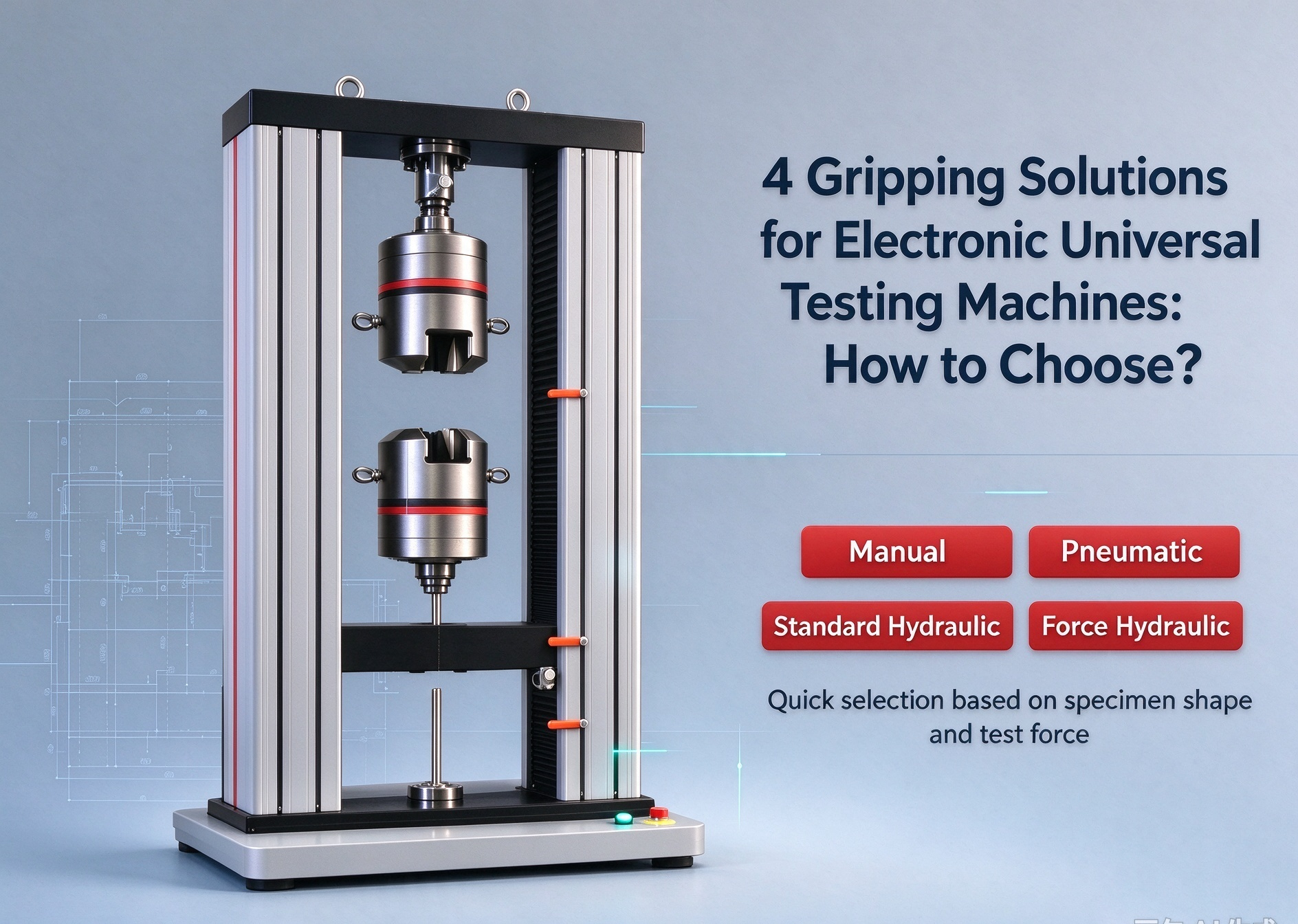
Fixture is a key link that affects the test data in material tensile test. Many customers will ask: manual clamping, pneumatic clamping, conventional hydraulic clamping and forced hydraulic clamping, what are their differences? How much test force is it, and what sample is it suitable for? There is no difference between the advantages and disadvantages of the four schemes, but the driving form and clamping structure are different, and the suitable samples, loads and application scenarios have their own emphasis. Only by choosing the right fixture can we get stable and reliable test data. Manual Clamping | Manual Tightening The jaws are manually tightened by screw and handwheel to clamp the sample. Recommended force value: ≤200kN Adapted samples: all kinds of metal plates, flat samples and round bar samples. The scene features of small batch of samples: simple structure, low cost, no need for gas source and hydraulic station; The clamping force depends on manual hand feeling, and the consistency is influenced by the operator. Batch test is time-consuming and laborious. It is suitable for scenarios: laboratories with few samples, limited budget and low sampling frequency.
Pneumatic clamping | The cylinder-driven clamping depends on the cylinder to provide power, and the two-way jaws clamp the sample oppositely. Recommended force value: ≤10kN Adapted samples: films, thin plastic sheets, small nonmetallic samples, and low-strength composite samples Features: clean and free of oil stains, quick action and simple maintenance; The upper limit of clamping force is low, which is greatly influenced by the fluctuation of air source pressure. Applicable scenarios: nonmetallic sample detection with small load and cleanliness requirements.
Conventional hydraulic clamping | Two-side opposite clamping hydraulic drive two-way clamping structure, two-side jaws face to face clamping samples, a classic clamping form in the industry. Recommended force value: 10kN~300kN Suitable samples: flat cross-section samples such as metal plates, flat samples and flaky composite materials. Features: high adhesion to flat samples, sufficient clamping force, mature and stable scheme. Applicable scenarios: tensile test of various plates and flat samples, factory quality inspection, and high-frequency use of third-party inspection.
Strong-holding hydraulic clamping | Surrounding clamping around the hydraulic drive ring-shaped embracing structure, the jaws are synchronously held inward from the periphery of the sample, the clamping force is evenly distributed along the circumference, and the loading coaxiality is excellent. Recommended force value: 10kN~300kN Suitable samples: round steel, rebar, anchor rod, cylindrical composite rod (glass fiber rod, carbon fiber rod, etc.) Features of round and rod-shaped cross-section samples: large and stable clamping force, uniform surrounding stress, which can reduce local stress concentration and effectively avoid premature collapse failure of composite samples at the jaw position. Applicable scenarios: large-scale inspection of high-strength round rods, cylindrical composite materials and anchor rods.
In a word, quick manual clamping: the handwheel screw is locked, and the adaptation is ≤200kN, which is suitable for sampling scenes with few samples and limited budget. Pneumatic clamping: air cylinder driven clamping is suitable for small and medium-sized nonmetallic samples with low load, which is clean and convenient, and the clamping force is limited. Conventional hydraulic clamping ≤10kN is recommended: opposite clamping on both sides, giving priority to plate and flat samples (including flaky composite materials), and 10–300 kN strong clamping is recommended. Priority is given to round and rod-shaped samples (including cylindrical composite rods), with uniform stress and good coaxiality. It is recommended to use a 10–300 kn high-rigidity gantry machine with stable and reliable accuracy. The whole machine adopts a double-column aluminum alloy gantry frame with strong rigidity and small deformation during loading. The servo system is matched with precision ball screw, and the force, displacement and deformation are controlled in three closed loops. The test has good repeatability and can be tested continuously for a long time. The test function is comprehensive, compatible with many standards, supporting various mechanical tests such as tension, compression, bending, shearing, tearing and peeling, and automatically outputting key parameters such as tensile strength, yield strength, elastic modulus and elongation after breaking; Meet GB/T 228.1, GB/T 1040 and other national standards, be compatible with international standards such as ISO and ASTM, and be suitable for quality inspection of enterprises, CNAS laboratories, scientific research in universities and engineering inspection. Intelligent measurement and control software, the data can be traced back to the professional microcomputer measurement and control system, real-time data acquisition, drawing stress-strain curves, and multiple curves can be superimposed and compared; Test records are automatically saved, and reports are exported with one key, which is convenient for data archiving, laboratory review and project acceptance. Customized on demand, covering multi-industry detection metallurgy, mine support, rail transit, composite materials, auto parts, universities and third-party testing institutions; Multi-force specifications are optional, which can be matched with extensometer, high and low temperature environment box and non-standard tooling, and the whole scheme can be customized according to the sample shape and test standard. Briefly summarize the selection idea: the number of samples is small, the budget is limited, and manual clamping can be considered within 100kN; Thin nonmetallic samples with test force less than 10kN, pursuing cleanliness and convenience, optional pneumatic clamping; In the range of 10-200kN, conventional hydraulic clamping is preferred for plates, flat specimens and flaky composite materials; In the same range of 10–300 kN, many customers will give priority to the strong-embracing hydraulic clamping for circular cross-section samples such as cylindrical composite materials, round bars and anchor rods, so as to evenly encircle the stress, protect the samples and reduce the premature failure of the jaws. For high-strength samples exceeding 300kN, we can independently customize the large-tonnage hydraulic clamping scheme. Our factory provides direct supply, and each equipment is calibrated and debugged before leaving the factory, providing on-site practical training and after-sales maintenance, and supporting bidding projects. There are testing machine selection, fixture scheme, technical parameters and quotation requirements, welcome to consult privately! According to your sample specification, test load and execution standard, we will match the most suitable configuration for you. Ji 'nan Liling Testing Machine Co., Ltd.
Focus on R&D and manufacturing of mechanical testing equipment | Electronic universal testing machine, hydraulic universal testing machine, pressure testing machine, fatigue testing machine and various non-standard material mechanical testing machines support customization.

Manual torsion tester
Manual torsion testing machine, a high-precision portable to...
Digital display high strength bolt detector
High-strength bolt detector is currently a high-strength bol...
LS71-V Impact specimen notch manual broaching machine
LS71-V impact specimen notch manual broaching machine is a...
About LiLing
Product range
News
Contact LiLing
National Service Hotline:+86 18660398828
Address:Building 2, No. 6 Weihua West Road, Shizhong District, Jinan City, Shandong Province,China


Business consultation (WeChat)
Technical Support: ChaoYueHuLian
Links: